
Missing Tooth Replacement Options Explained

A missing tooth can change more than your smile. It can make chewing feel uneven, affect the way you speak, and put extra stress on the teeth around it. When patients ask about missing tooth replacement options, what they usually want is simple - a solution that feels comfortable, looks natural, and makes daily life easier again.
The good news is that there is no one-size-fits-all answer, because there are several reliable ways to replace a tooth. The better news is that modern dentistry gives us options for different budgets, timelines, and health needs. The right choice depends on where the tooth is missing, the condition of the surrounding teeth and gums, and what matters most to you.
Why replacing a missing tooth matters
Some people feel tempted to wait, especially if the missing tooth is in the back and not easy to see. That can seem reasonable at first, but over time the gap can create problems. Nearby teeth may start to shift, your bite can change, and the jawbone in that area may begin to shrink because it is no longer being stimulated by a tooth root.
That does not mean every situation is urgent in the same way, but it does mean the gap is worth evaluating sooner rather than later. Replacing a missing tooth is often about protecting your long-term oral health just as much as improving appearance.
Missing tooth replacement options to consider
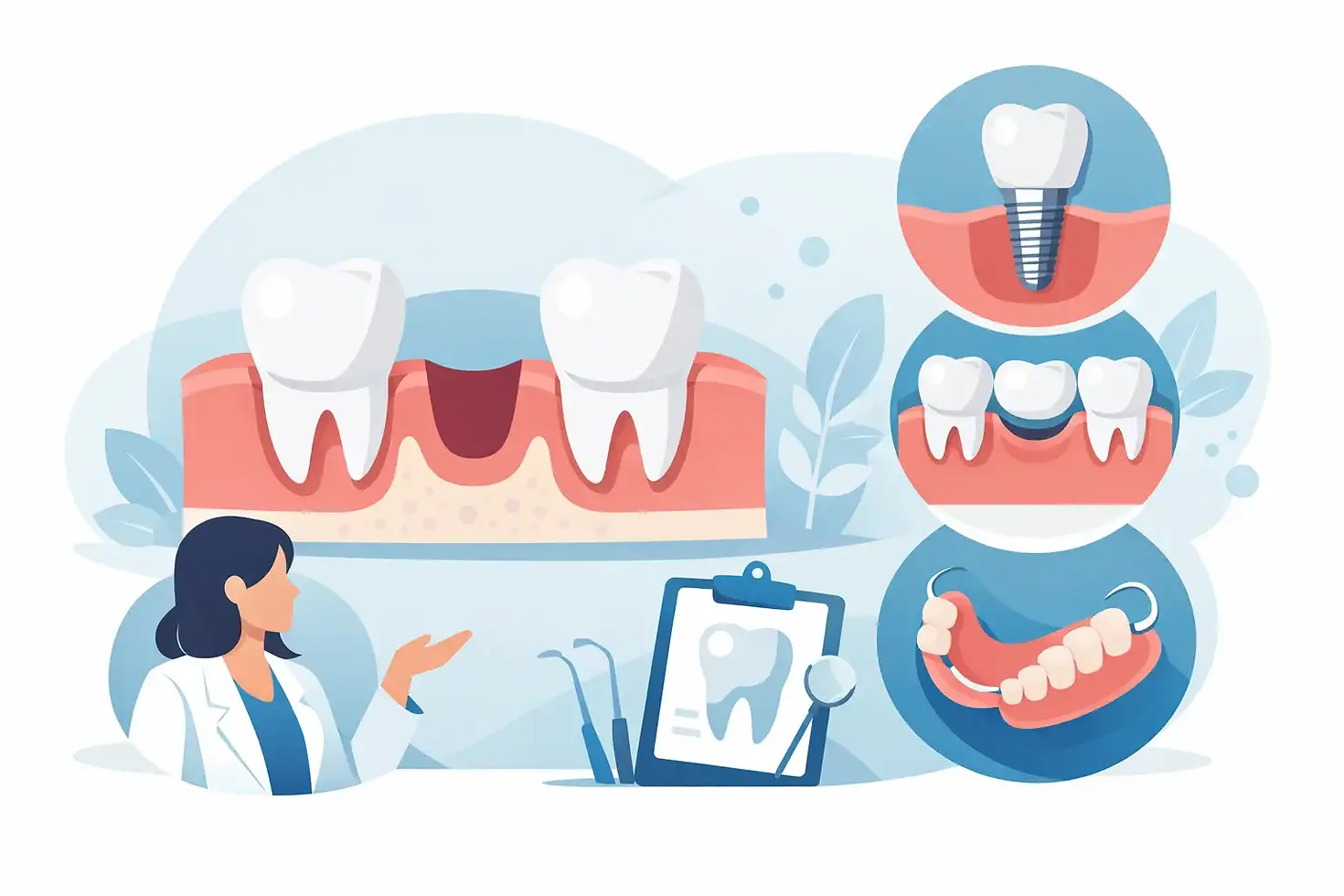
The three most common missing tooth replacement options are dental implants, dental bridges, and dentures. Each one has advantages, and each comes with trade-offs.
Dental implants
A dental implant is often the closest replacement to a natural tooth. The implant itself is a small post placed in the jawbone, and after healing, it supports a custom crown on top. Because it replaces the root as well as the visible tooth, it helps preserve bone and provides strong support.
For many adults, implants are the most stable and natural-feeling option. They do not rely on neighboring teeth for support, and they can be brushed and flossed much like a natural tooth. Patients also like that implants tend to stay in place without slipping or shifting.
Still, implants are not automatically the best choice for everyone. They usually involve a longer treatment timeline, especially if bone grafting or healing time is needed. They can also cost more upfront than other options, though many patients feel the long-term value is worth it because of their durability and comfort.
A healthy jawbone and healthy gums are important for implant success. If you have bone loss, gum disease, or certain medical conditions, treatment may need to be planned more carefully. That does not rule implants out, but it may affect timing and complexity.
Dental bridges
A dental bridge fills the gap by anchoring an artificial tooth to the teeth on either side. In a traditional bridge, the neighboring teeth are shaped so crowns can support the replacement tooth in between.
A bridge can be a very practical solution when the teeth next to the gap already need crowns or have large fillings. It can usually be completed faster than an implant and often has a lower upfront cost. For many patients, that combination of function, appearance, and timeline makes a bridge a strong option.
The main trade-off is that a bridge depends on the adjacent teeth. If those teeth are healthy and untouched, preparing them for crowns may feel like a bigger commitment. Bridges also do not replace the root in the jawbone, so they do not prevent bone loss the way an implant can.
With good home care and regular dental visits, bridges can last for many years. They do require careful cleaning around and underneath the replacement tooth to keep the supporting teeth and gums healthy.
Dentures
Dentures are removable replacements for missing teeth. They can replace a single tooth, several teeth, or a full arch. Partial dentures are used when some natural teeth remain, while full dentures are used when all teeth in an arch are missing.
For patients missing multiple teeth, dentures can be one of the most accessible treatment paths. They are generally less expensive than replacing each tooth with an implant, and they can restore appearance and basic chewing function in a relatively short timeframe.
That said, dentures often involve an adjustment period. Some patients notice sore spots, movement, or changes in speech at first. Lower dentures in particular can feel less secure than upper dentures because of the way they sit in the mouth.
Modern dentures can look much more natural than people expect, but they still differ from natural teeth. For some patients, implant-supported dentures offer a helpful middle ground. These use implants to hold a denture more securely, which can improve comfort and confidence while still replacing many teeth at once.
How to choose between missing tooth replacement options
The best way to choose among missing tooth replacement options is to look at the full picture, not just one factor. Cost matters, of course, but so do comfort, longevity, oral health, and how much treatment you are comfortable with.
If you want the most natural function and long-term bone support, an implant may be the strongest choice. If you want a fixed solution without surgery and the neighboring teeth already need restorative work, a bridge may make more sense. If you need to replace several teeth in a budget-conscious way, a partial denture or full denture may be the right fit.
This is also where personalized care really matters. Two patients can have the same missing tooth and still need different recommendations. One person may have plenty of bone for an implant and want the most permanent option. Another may prefer a shorter timeline or need a treatment plan that works within a certain budget. Honest guidance should make those differences feel manageable, not overwhelming.
Questions patients often have about tooth replacement
One common question is whether replacing a back tooth is really necessary. In many cases, yes. Even if it does not show when you smile, a back tooth does a lot of work during chewing. Losing it can put added pressure on other teeth and gradually affect your bite.
Another frequent concern is pain. Most people are relieved to learn that modern dental treatment is more comfortable than they expected. Numbing techniques, thoughtful planning, and options like sedation can make the process much easier, especially for patients who feel nervous about dental work.
Patients also ask how long treatment takes. A bridge may take a few visits. A denture timeline depends on the type of appliance and whether extractions are needed. An implant often takes longer because the bone needs time to heal around it, but that slower process is part of what gives it strength.
What happens at a consultation
If you are not sure which option is right, a consultation is the best place to start. Your dentist will examine the area, evaluate your gums and bone, look at your bite, and talk with you about your goals. X-rays or digital imaging may be used to understand what is happening below the surface.
Just as important, this conversation should leave room for your preferences. Some patients care most about keeping treatment as conservative as possible. Others want the option that feels closest to a natural tooth. Some want to move quickly. Others want to plan in stages. A good treatment plan should reflect your health needs and your comfort level.
At West 56th Dental, that kind of conversation matters. Patients deserve clear explanations, honest recommendations, and a care experience that feels supportive from start to finish.
A comfortable path forward
Living with a missing tooth does not mean settling for discomfort or hiding your smile. Whether the right answer is an implant, a bridge, or a denture, there is usually a way to restore function and help you feel like yourself again. The most helpful next step is simply getting the gap evaluated, so you can move forward with confidence and a plan that fits your life.


Comments